In this guide
What professional service actually buys
Every February, Buffalo divides into two kinds of driveways: the ones that were cleared before the commute, and the ones being negotiated with at 6:40 a.m. The difference is rarely effort — plenty of homeowners out-work any crew. It is system: weather monitoring that dispatches crews at a written trigger depth, routes planned so your street is reached predictably, two-stage equipment sized for wet lake-effect loads, and a contract that makes reliability someone’s job instead of someone’s hobby.
That last part is the piece the price really carries. A good contract puts the trigger, the response window and the scope in writing — which means that when a truck breaks at 4 a.m. in the middle of a storm, backup equipment is the company’s problem, not your morning’s.
How a professional crew actually runs a Buffalo storm
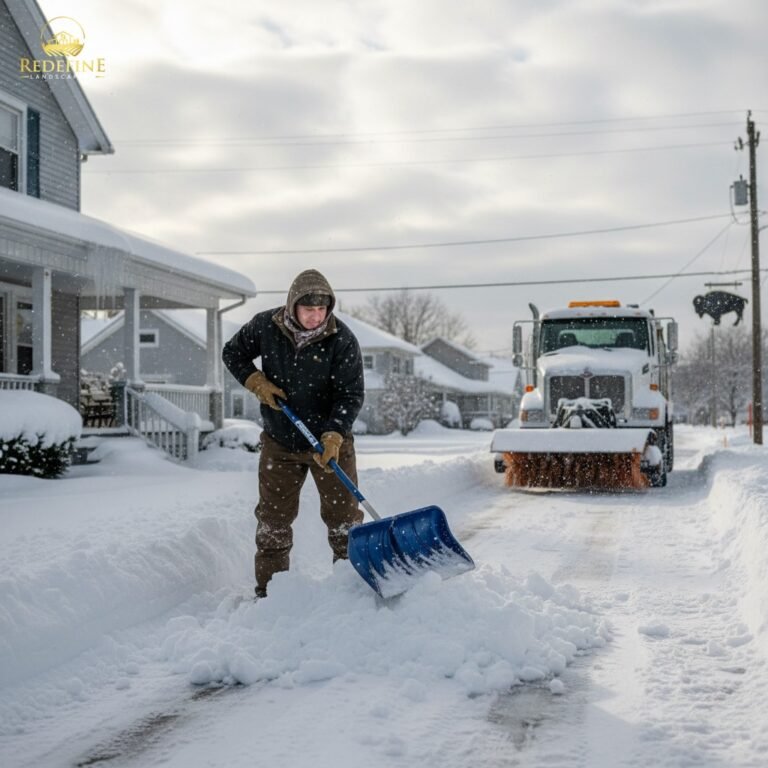
The work starts before the snow does. Forecasts get watched days out; for a serious lake-effect setup, crews pre-stage — equipment fueled and positioned, routes resequenced for where the band is aimed, salt loaded for the surfaces that will need pre-treatment. When accumulation crosses the trigger — ours is a 2″ default, with 24/7 storm dispatch — the route begins, in an order designed so that commuter households are open before the morning and commercial lots before their doors do.
During a multi-day event, the route simply runs again — the same discipline this region demands of anyone clearing their own snow: little and often beats one heroic dig. And every commercial visit is logged with a time stamp, because in this business the paper trail is part of the product.
What it protects: your property
An inexperienced blade is hard on a property in ways that surface in April. Professional crews are paid to prevent the damage, not just move the snow:
- Turf edges — staked in November so the blade finds pavement, not lawn, in a whiteout. The gouged brown border every spring is what unstaked plowing looks like.
- Concrete and pavers — measured de-icing with the right product instead of a heavy hand with rock salt, which pits young concrete and burns everything green beside the walk.
- Drainage — snow piled where melt can leave, not against the foundation or over the storm drain. Where the snow goes is a decision, and professionals make it before the season, with you.
- Plants and beds — kept out of the pile zones entirely, because plowed snow arrives with salt and gravel in it.
What it protects: the people on it
Two risks sit under every Buffalo winter, and both are why “professional” is a safety category before it is a convenience one. The first is exertion: shoveling heavy snow in cold air is among the most strenuous things most adults do all year, and for anyone with a heart condition or a doctor’s caution about heavy effort, a seasonal contract is a health decision. The second is liability: the melt-refreeze glaze on an untreated walkway is where winter injuries actually happen — to your family, your mail carrier, your guests — and timed, measured de-icing is precisely the part of the job DIY schedules miss.
The hosting season nobody plans for
Buffalo’s heaviest snow months are also its hosting months — Thanksgiving through the holidays means more cars, more foot traffic, and guests who do not know where your walkway ices over. If you host, tell your provider: entrances and guest parking can be in scope, cleared and treated before people arrive rather than after someone slips. It pairs naturally with the season’s other outdoor job — our Christmas lighting crews and snow crews work the same properties all winter.
The honest math
A seasonal contract for a standard Buffalo driveway runs $450–$900; a capable snowblower costs $600–$1,500 up front plus fuel, maintenance and 10–20 early mornings of your winter. Over several mild seasons, DIY wins on paper. The contract wins on the mornings, the heavy storms, the snow-belt addresses, and every household where the person holding the shovel should not be — the full comparison, with sources, is in our Buffalo snow removal cost guide.
What tips the decision for most people is not the average winter. It is the bad one — the winter of 25 plowable events, when per-effort approaches cost the most exactly when they deliver the least. Professional service is how you hand that risk to the party built to hold it.
Professional snow removal: FAQ
Is professional snow removal worth it in Buffalo?
For commuters, snow-belt addresses, and anyone who should not be shoveling — usually yes. You are buying certainty in a 95-inch city: a written trigger, a predictable route, and the bad-winter risk carried by the contractor instead of you.
What does it cost?
$450–$900 per season for a standard driveway, $35–$60 per visit, more for long rural lanes and snow-belt zones — full market breakdown in the cost guide.
When do crews actually come?
At the contract’s trigger depth — 2 inches is the WNY standard — on a planned route, around the clock during storms. During multi-day events the route simply runs again.
Does professional plowing damage lawns?
Done properly, no — edges are staked before the season and the blade runs on pavement. Spring plow damage is the signature of unstaked, inexperienced clearing, and a professional contract should say how any damage is repaired.
How do I pick a good company?
Ask the eight questions in our hiring guide — trigger in writing, insurance shown, backup equipment named. Any company that answers all eight cleanly is a legitimate choice.
Snow removal cost in Buffalo, NY · How to choose a snow removal company · The Buffalo winter maintenance checklist · All winter care guides
Related Guides